
Start with one pool, not three mini-decks
Each hero has personal progression, but every contributed card joins one shared draw pool. A choice from Anton's tree cannot be judged only beside other Anton choices, and the same rule applies to Yana and Lev. Read the card in the mixed hand the party actually receives: can it help before the closest enemy countdown, can either teammate make useful use of the position it creates, and does adding it reduce access to a contribution the plan needs more often? This is the first test because ownership explains where a card came from, not who exclusively benefits from drawing it.
A specialized party plan can still work, but the surrounding contributions must support it when they appear in different orders. A broader plan can also fail if it fills the pool with narrow cards that each require a separate setup. Define the repeated party sequence before accepting more cards. State what the group should be able to accomplish before an announced action, what kind of contribution can begin that sequence, and which follow-up remains useful when drawn beside cards from either of the other heroes. That rule gives every later skill and equipment choice a common standard.
Review additions by asking two probability questions rather than treating growth as automatically positive. First, what useful mixed hand becomes more likely because this card is present? Second, what existing contribution becomes harder to find after the pool grows? The interface does not need to expose a complete numerical model for those questions to be useful. Observe whether real hands repeatedly reach the intended timing state, note when several cards compete for the same job, and keep a new contribution only when it strengthens the party sequence often enough to justify the extra draw competition.
Record why each card entered the deck
A card can enter the shared pool through personal progression or through equipment. Record that source when reviewing a weak hand. If several cards compete for the same timing role, knowing whether they came from a skill choice, weapon, armor piece, or memory identifies the smallest decision that can be tested without dismantling the rest of the party. Source tracking also prevents a common diagnostic error: blaming the hero who drew a card instead of the progression or item that originally placed it in the common pool.
The source clarifies what else changes when the contribution is removed. Replacing equipment can alter the wearer's playstyle and the shared deck at the same time, while respec revises a personal tree. Keep the other trees and equipment stable, change one source, and compare later hands against the same questions: which enemy action was nearest, which party sequence was available, and which contribution arrived without a useful partner? A controlled comparison makes the result understandable even when the exact draw probabilities are not displayed as numbers.
Use the source field as a practical route back from combat to build planning. When a card repeatedly arrives too early, too late, or beside competing setup, identify its owner, then identify the skill or item that supplied it. Decide whether the problem is the contribution itself or the surrounding pool. Sometimes the cleaner repair is not removing that card but reducing another addition that performs the same timing job. Recording the insertion path keeps the review attached to choices the player can actually change instead of turning one awkward hand into a vague judgment about an entire hero.
| Field | What to record | Why it matters |
|---|---|---|
| Owner | Anton, Yana, or Lev progression | Connects the card to the personal tree that supplied it |
| Source | Skill choice or equipment | Shows which build decision can be tested |
| Timing job | What countdown condition it answers | Prevents evaluating only the immediate effect |
| Mixed-hand partners | Useful contributions from either teammate | Tests whether the card belongs in one shared pool |
| Draw consequence | What becomes less likely after insertion | Treats deck growth as a probability tradeoff |
Audit real hands for sequence quality
After combat, classify the problem that actually appeared. Did the party lack an answer before the nearest countdown, draw several setup contributions together, find a useful card only after its timing window, or hold cards that wanted incompatible follow-ups? Write the failure in terms of the whole sequence rather than the apparent strength of one effect. This separates a deck problem from a play-order problem: a suitable answer may already have been present but used before the queue was read, while a clean sequence may have been impossible because the necessary contributions rarely appeared together.
Look for a repeating pattern across several hands before changing the build. One awkward draw does not establish that a contribution is wrong, but recurring competition for the same timing window is actionable. Compare similar situations: note the closest announced action, the cards available from all three heroes, the first play chosen, and the condition left for the following countdown. When the same missing link or redundant role appears again, trace it to the progression or equipment source that can be adjusted with the least disruption.
Run the next audit as a controlled test. Change one personal branch or one item, leave the remaining sources stable, and judge the replacement under the same party rule. A useful repair should do more than create one impressive hand; it should make coherent mixed sequences easier to recognize while preserving an answer for the visible enemy queue. If the outcome is unclear, restore the prior setup before testing another variable. This method produces a dependable build history without claiming a universal sample size, a hidden formula, or a best deck that applies to every campaign choice.
Use the library without inventing completeness
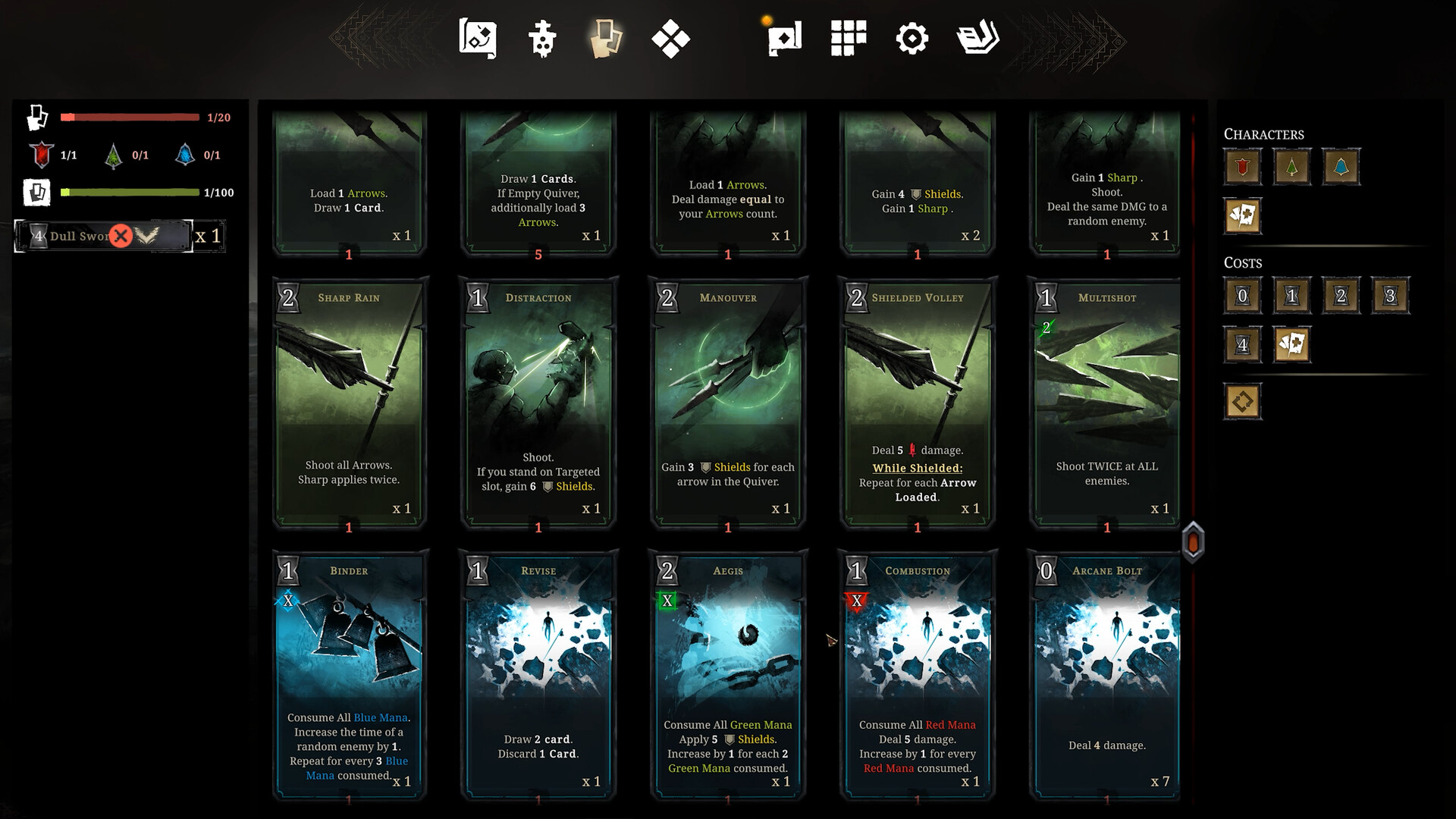
Official screenshots show a card library and visible groupings, but the current first-party record does not establish a safe complete count, full list, or final taxonomy for this wiki. A single frame can be cropped, filtered, version-specific, or unable to show entries outside the visible panel. The library is therefore used as proof that cards can be inspected and organized, not as permission to convert every readable fragment into a supposedly complete database. The page keeps the useful system relationship while refusing a total that cannot be reproduced from the published material.
Separate a visible record from a complete catalog. A readable card in an official interface can support discussion of the interface or the relationship shown in that frame, but it does not prove how many other cards exist, whether every grouping is visible, or whether the displayed state represents the entire released build. Do not multiply rows, extrapolate from scroll position, or assign names to artwork that lacks a readable label. Those shortcuts create false precision and make later corrections harder when a fuller game-derived record becomes available.
A future complete reference should preserve every name and relationship from a reproducible source, record the game version or capture date, and distinguish cards supplied by progression from cards supplied by equipment. Until that standard can be met, the durable player value is the evaluation method: identify owner and insertion source, define the countdown job, test partners from both teammates, and judge the draw competition introduced by the addition. That approach remains accurate even as the catalog grows, because it describes how the verified shared-deck system should be read rather than pretending the current page already contains every entry.
Frequently asked questions
Does each hero have a separate deck?
No. Official material states that Anton, Yana, and Lev draw from one shared deck. Personal skill trees still matter because a progression choice can supply a hero-associated card, and equipment can also add cards, but those contributions enter a pool used by the whole party. When a hand feels inconsistent, trace the troublesome card back to the tree or item that inserted it, then evaluate the change at party scale. Removing or adding one contribution changes what all three heroes are likely to draw beside one another; it is not merely a private adjustment to the named owner.
How many cards are in Shards of Order?
The available first-party material does not support a complete, reproducible card total for this reference. Official screenshots show a library and visible card groupings, but one interface frame cannot prove that every entry, filter, or version-specific card is present. This page therefore avoids a guessed count and does not manufacture unreadable names. It focuses on facts that remain useful without a total: all three heroes share one pool, cards can come from personal progression or equipment, every addition changes party draw odds, and a card should be judged by its timing job and mixed-hand partners.