
Read the enemy queue before the hand
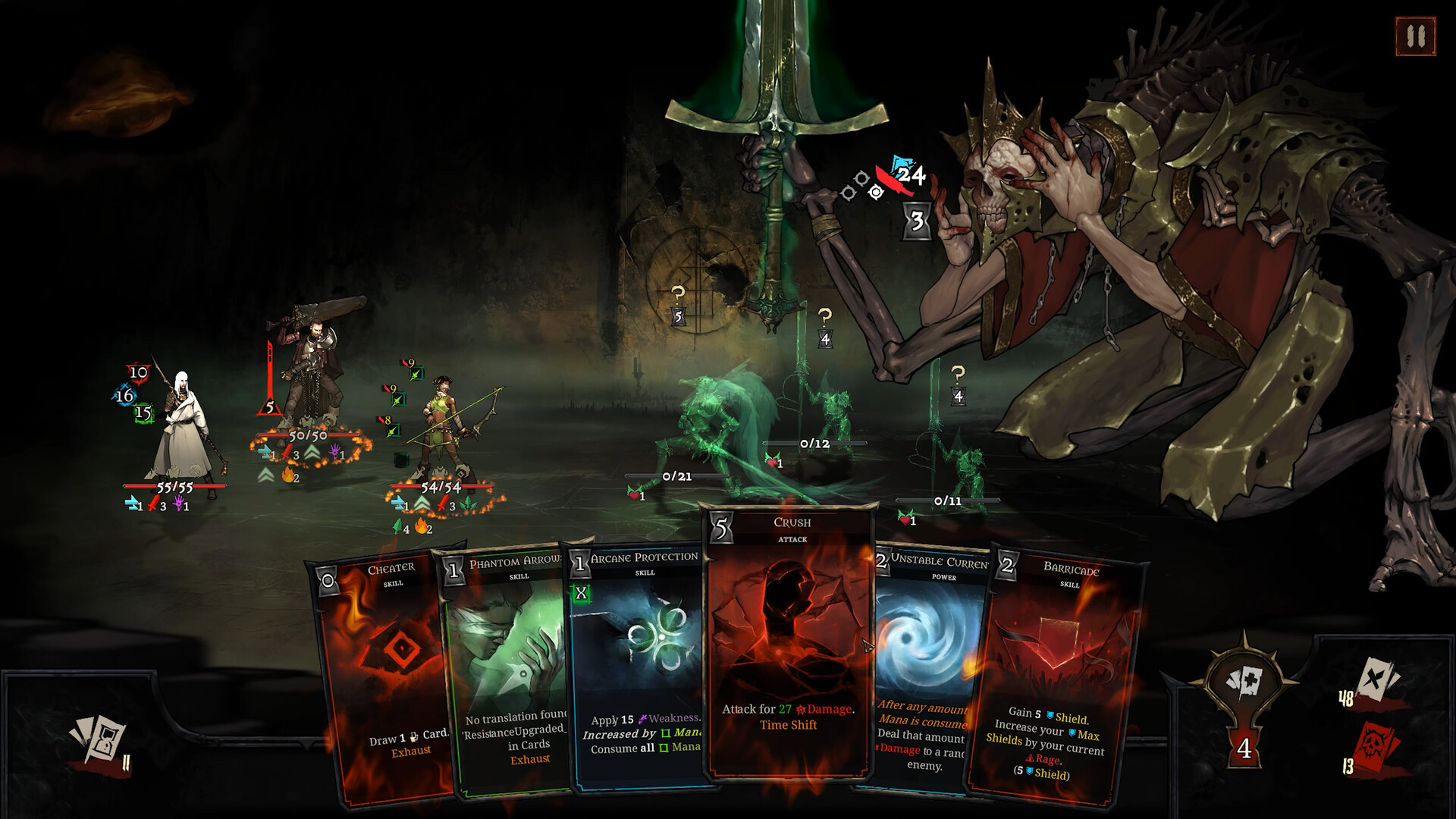
Begin with the closest visible enemy action. Its countdown defines the first timing boundary the party must cross safely. Then read the other announced actions in order, because the nearest threat is not the only one the current sequence can accelerate. This establishes the problem before an attractive card effect distracts from the clock that actually determines the next danger. The goal of the first scan is not to choose a card yet; it is to state what condition Anton, Yana, and Lev must reach before the first action resolves and what pressure follows immediately afterward.
Now read the shared hand. Identify which contributions can answer the nearest action, which cards prepare a later answer, and which play would move the queue without improving the party's position. The absence of conventional turns means there is no automatic round boundary at which priorities reset. A sequence that looks complete under turn-based assumptions may end with an enemy action arriving sooner than expected. Re-evaluate every visible countdown after each card and treat the changed order as a new decision state rather than continuing a script written for the previous state.
Use a compact pre-play check when several options look plausible. Name the first announced action, the party condition required before it arrives, the card that creates that condition, and the answer still available for the following countdown. If a candidate play cannot explain those four points, delay it until the queue has been read again. This method does not assume undocumented formulas or fixed card roles. It simply keeps the visible timing information, the mixed three-hero hand, and the next party state connected throughout the sequence.
Treat timing as the card cost
Without a mana pool, the usual question of whether the player can afford a card becomes a timing question: can the party afford what happens on the clock after playing it? Compare candidate cards by the immediate condition they create and by how far they move the visible enemy actions. A powerful effect may be too slow for the nearest threat, while a modest response may preserve the sequence needed for the following countdown. The relevant cost is therefore not a hidden resource estimate but the observable position the party accepts when the card advances the shared timeline.
Build a short line rather than committing to a long script. Choose the first card, observe the changed counters, and decide again. This keeps planning precise when one play alters the order or urgency of several actions. It also exposes when a planned combination depends on a round-based assumption that the system does not use. A useful line has a clear stopping point: once the required party condition is reached, pause and read the queue rather than spending another card merely because it was included in the original idea.
When comparing two lines, record the state each one leaves behind. Which enemy action is now closest, what flexible contribution remains in hand, and can the next hero-associated card still connect with the plan? This makes timing comparisons practical without inventing a universal value for every card. The better sequence is the one that reaches the necessary condition while preserving a workable response to the visible queue, not automatically the one with the largest isolated effect or the greatest number of cards played.
| Read | Question | Common error | Correction |
|---|---|---|---|
| Nearest countdown | What must be true before it resolves? | Starting with the largest effect | Choose the first safe timing line |
| Following countdown | What remains after answering the first? | Spending every flexible response | Reserve a useful second answer |
| Shared hand | Which heroes can contribute now? | Solving one hero in isolation | Read all three contributions together |
| Card order | How does each play change the queue? | Planning as if a round will reset | Re-read the clocks after every card |
Manage one clock for the whole party
Anton, Yana, and Lev do not operate as three isolated turn schedules. Their available cards meet in one hand and their choices consume the same combat timeline. Support, pressure, setup, and protection therefore belong to one ordered sequence. A card associated with one hero can create the safe window in which another hero's contribution becomes useful, while a poorly timed personal action can consume the window the rest of the party needed. Read ownership as the source of a contribution, not as a separate clock reserved for that hero.
Judge a hand by the party state it can reach before the closest action, not by how many individually strong cards it contains. If several cards compete for the same timing window, identify which contribution is essential and which can move to a later window. Then check whether the delayed contribution still has a useful partner after the first enemy action. This prevents the first solution from exhausting every flexible option and turning the following countdown into a new emergency with no coherent sequence left.
The shared clock also changes how specialization should be evaluated. Distinct personal playstyles can cooperate when their contributions form a readable order, but fixed class labels are not required to describe that order. State the relationship directly: one card prepares a condition, another uses it before an announced action, and a third preserves the party for what follows. If the hand repeatedly cannot produce that relationship, return to the shared deck and inspect which progression or equipment additions are competing for the same point on the timeline.
Use combat hands as build feedback
Repeated hands reveal whether the three personal progressions cooperate. If a hero's cards regularly arrive without the support or timing they need, inspect the skill and equipment choices that placed those cards in the common pool. The problem may not be the card's immediate effect; it may be that the shared deck produces too many contributions that want the same setup or the same countdown window. Before changing the build, confirm that the sequence was not lost simply because the enemy queue was read too late or a flexible answer was spent on the wrong action.
Change one source of cards at a time through respec or an equipment swap, then compare later hands under similar timing questions. Track whether the party can answer the nearest action, preserve a response for the next one, and still advance its intended plan. Keeping the other trees and items stable gives the comparison a clear meaning. If several variables change together, an improved hand cannot show whether the repair came from removing a competing card, strengthening the wearer's playstyle, or changing the order in which useful contributions appear.
Maintain a short observation record rather than a tier list. For each test, note the changed source, the first two visible enemy actions, the useful mixed sequence that appeared or failed to appear, and the party state left after the final card in the line. Review patterns, not one dramatic result. This connects combat observation to deck construction while respecting the boundaries of the published data: the process can identify a more coherent setup for the current party without claiming an undocumented best build, exact probability, or universal answer for every encounter.
Frequently asked questions
Does Shards of Order use turns or mana?
No. The official store describes combat without conventional turns or mana points. Enemy actions are announced through visible countdowns, and playing cards moves those countdowns, so every choice has both an immediate effect and a timing consequence on the party's shared combat clock. Read the nearest action first, decide what condition all three heroes must reach before it resolves, and then re-check the queue after each card. A familiar turn-based idea such as finishing a planned combo before the round ends is unsafe here because the system does not promise that kind of reset boundary.
Should I always answer the closest countdown first?
The closest action sets the first boundary, but a safe sequence also considers what follows it. A response that spends every flexible contribution may survive the nearest threat and leave no answer for the next visible action. Read at least the first two countdowns, identify which cards can remain useful after the first is handled, and re-evaluate the order after every play. This guide does not prescribe one universal response because card effects and party builds vary; it provides a queue-reading method that keeps the immediate requirement and the following timing window in the same decision.